Thursday, September 23, 2010

‘Best Game Ever’ Broadcast Found in Bing Crosby’s Wine Cellar

 
(Associated Press) Pittsburgh Pirates vice president Bing Crosby, center,
with co-owner and treasurer John W. Galbreath, left, and President Frank McKinney,
at the season opener at Wrigley Field in Chicago, Ill., in 1947.

By Richard Sandomir
New York Times

September 23, 2010

How a near pristine, black-and-white reel of the entire television broadcast of the deciding game of the 1960 World Series — long believed to be lost forever — came to rest in the dry and cool wine cellar of Bing Crosby’s home near San Francisco is not a mystery to those who knew him.

Crosby loved baseball, but as a part owner of the Pittsburgh Pirates he was too nervous to watch the Series against the Yankees, so he and his wife went to Paris, where they listened by radio.

“He said, ‘I can’t stay in the country,’ ” his widow, Kathryn Crosby, said. “ ‘I’ll jinx everybody.’ ”

He knew he would want to watch the game later — if his Pirates won — so he hired a company to record Game 7 by kinescope, an early relative of the DVR, filming off a television monitor. The five-reel set, found in December in Crosby’s home, is the only known complete copy of the game, in which Pirates second baseman Bill Mazeroski hit a game-ending home run to beat the Yankees, 10-9. It is considered one of the greatest games ever played.
 
(Associated Press) The Pirates’
catcher Hal Smith, right, and his
eighth inning homer to put
Pittsburgh on top, 9-7.
Crosby, the singer and movie and TV star, had more foresight than the television networks and stations, which erased or discarded nearly all of the Major League Baseball games they carried until the 1970s.

A canny preservationist of his own legacy, Crosby, who died in 1977, kept a half-century’s worth of records, tapes and films in the wine cellar turned vault in his Hillsborough, Calif., home.

“Bing Crosby was way ahead of his time,” said Nick Trotta, senior library and licensing manager for Major League Baseball Productions, the sport’s archivist. Three years ago, baseball acquired the rights to Yankees pitcher Don Larsen’s perfect game in the 1956 World Series — leaving the finale of the 1960 World Series high on its wish list. The hunt for old games — this one unseen on TV since its original broadcast — is constant, serendipitous and often futile. Great games like the Game 7 in 1960 are often recalled with just a few newsreel clips.

Crosby was so superstitious about hexing his Pirates that he and Kathryn listened to the game with their friends Charles and Nonie de Limur in Paris.
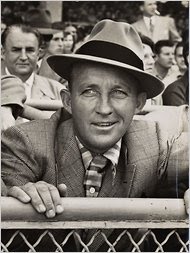
(Bing Crosby Enterprises)
Bing Crosby, who was part owner
of the Pittsburgh Pirates,
hired a company to record
Game 7 by kinescope,
an early relative of the DVR.
“We were in this beautiful apartment, listening on shortwave, and when it got close Bing opened a bottle of Scotch and was tapping it against the mantel,” Kathryn Crosby said. “When Mazeroski hit the home run, he tapped it hard; the Scotch flew into the fireplace and started a conflagration. I was screaming and Nonie said, ‘It’s very nice to celebrate things but couldn’t we be more restrained?’ ”

After Crosby viewed the 2-hour-36-minute game, probably in a screening room in the house, the films took their place in the vault, said Robert Bader, vice president for marketing and production for Bing Crosby Enterprises.

They remained there undisturbed until December when Bader was culling videotapes of Crosby’s TV specials for a DVD release — part of the estate’s goal of resurrecting his body of work.

He spotted two reels lying horizontally in gray canisters labeled, “1960 World Series.” They were stacked close to the ceiling with home movies and sports instructional films. An hour or so later he found three others on other shelves. Intrigued, he screened the 16-millimeter film on a projector. It was Game 7, called by the Yankees’ Mel Allen and the Pirates’ Bob Prince — the complete NBC broadcast. The film had not degraded and has been transferred to DVD.

“I had to be the only person to have seen it in 50 years,” Bader said. “It was just pure luck.”

Bader’s call to baseball last spring initiated months of talks that have led to an agreement allowing the MLB Network to televise the game in the off-season, and wrap interviews and other programming around it, with Bob Costas as the host.

“It’s a time capsule,” Trotta said.

Hearing of the broadcast’s discovery, Jim Reisler, a historian born in Pittsburgh, sounded stunned.

“Wow,” he said. His book about the game — “The Best Game Ever” — would have benefited from seeing the NBC production, he said; he relied on the radio call. “It would have given me a greater sense of the tremendous ebb and flow of the game,” he said.

Dick Groat, the Pirates shortstop, said: “It was such a unique game to begin with. It was back and forth, back and forth. It was unbelievable.”

The production is simple by today’s standards. NBC appeared to use about five cameras. The graphics were simple (the players’ names and little else) and rarely used. There were no instant replays, no isolated cameras, no dugout reporters and no sponsored trivia quizzes.

Viewers looked at the hand-operated Forbes Field scoreboard that on that day (of 19 runs and 24 hits) got a vigorous workout. Occasionally they saw newsreel cameras atop the ballpark roof.

Price and Allen rarely interacted; the former called the first half, Allen the second half — putting him on the air for Yogi Berra’s three-run homer in the sixth inning (Allen first called it foul); Pirates’ catcher Hal Smith’s eighth inning homer to put Pittsburgh on top, 9-7 (“That base hit will long be remembered,” Allen said as the film showed Roberto Clemente — Allen called him Bob —bounding around the bases with joy); and Mazeroski’s winning drive to left field (“And the fans go wild,” Allen said).

The game included the play in which a ground ball hit by Bill Virdon to Yankees shortstop Tony Kubek kicked off the dirt and hit him smack in the Adam’s apple. He fell on his back, sat up within a minute looking dazed, stood up, then lobbied Manager Casey Stengel unsuccessfully to stay in.

It also included a daring example of base-running savvy by Mickey Mantle with two outs in the top of the ninth, in which he deked Pittsburgh first baseman Rocky Nelson and dived safely back into the bag just as Gil McDougald was reaching home to tie the score, 9-9.

Had Mantle been tagged out, McDougald’s run probably would not have counted and the game would have been over.

“How about that?” Allen said after Mantle’s play. But just minutes later, Mazeroski stepped to the plate. NBC’s sound was good enough to hear a fan shout, “Just get on, Billy, get on!” Mazeroski did more than that. After his home run, fans poured onto the field and danced on the Pittsburgh dugout.

Only later did Bing Crosby witness the joy and jubilation recorded just for him.

“I can still see Bing hitting the mantel with the Scotch,” Kathryn Crosby said.

From the New York Times

Saturday, September 18, 2010

Ballpark Farewell, Played Adagio

By KAREN CROUSE
New York Times
September 17, 2020


CHICAGO — On a gray, damp morning this week, the home of Nancy Faust, White Sox organist, was alive with the sound of ring tones.

A young man who met Faust at a game when he was a teenager called to say he had bought tickets to Saturday’s game and was bringing his girlfriend. A woman who met Faust years ago when she and her husband had season tickets phoned to firm up plans to attend the same game as one of Faust’s 50 guests.

A series sweep by the Minnesota Twins had dropped the White Sox out of the playoff race faster than the setting sun. But for fans of the 63-year-old Faust, the team’s remaining day games at U.S. Cellular Field are steeped in meaning, starting with Saturday’s against the Detroit Tigers, which has been designated “Faust Fest.”

After providing the home soundtrack for the White Sox for 41 years, Faust is retiring at the end of the season. Her music has been the grace note bridging memorable eras in the team’s history, from the baseball barker Bill Veeck to the showman Ozzie Guillen.

Faust was an innovator, choosing songs that played off names like a musical Chris Berman. She has a knack for matching songs to on-field situations, perhaps the most famous example being her inspired choice of Steam’s “Na Na Hey Hey Kiss Him Goodbye” when an opposing pitcher was pulled in the heat of the 1977 pennant race. For White Sox fans, the song became a part of the everyday rotation, right up there with “Take Me Out to the Ball Game.”

In the encyclopedia “Total White Sox,” it is written of Faust, “At times she was the best thing the ball club had going.”

Her role in recent years has been reduced, and her swan song has the feel of a requiem for baseball purists. The organ is being phased out of ballparks, with teams opting for keyboardists or canned music and video entertainment to pump up the fans’ experience.

What results is the sporting equivalent of FM radio, with the music virtually the same from one city to the next. In the effort to create a more interactive fan experience, is an intimate connection being lost?

Eric Carlson, who is 29 and a lifelong White Sox fan, believes so. He met Faust as a teenager when he approached her booth behind home plate during a game to suggest she play “Around the World” by the group ATC.

When he returned to his seat and heard the strains of the song fill U.S. Cellular Field, Carlson said: “I felt special. I was thinking, of all the people in the stadium, she was playing that song for me.” Speaking by telephone, he added: “Most of the players, they don’t even want to give you the time of day anymore. But Nancy’s very down to earth and approachable.”

Carlson, though part of the generation that is the target of baseball teams’ entertainment upgrades, remains an unabashed fan of Faust. “Some of the songs she plays, I feel they actually sound better than the originals,” he said, adding: “I’m a Sox fan, so I’ll still go to games after this year. But it won’t be the same.”

Society has changed, Faust said, and the differences are reflected in ballpark entertainment. Whereas she used to play a song in its entirety, she is now limited to 20- or 30-second snippets. “What I’m doing is sound bites,” she said, adding, “I don’t want that to be my legacy.”

Since 2005, she has worked only day games. The team is interviewing organists for her position.

The people who say organ music gives a ballpark the feel of a cathedral are being supplanted by the likes of Guillen, the White Sox manager who grew up in Venezuela, where he said organ music was not part of the game-day experience.

Guillen compared Faust’s music to the vuvuzela, the South African horn. “At the beginning of the season, it’s fun,” he said. “Now in June or July, it gets old.”

Faust was 23, with a striking resemblance to Joyce Bulifant, the actress who played Murray Slaughter’s wife on “The Mary Tyler Moore Show,” when she was hired in 1970 to play the organ at White Sox home games.

From her perch in center field — where Veeck had placed the organ booth in 1960 to foster fan interaction — Faust could see a petition being passed around the crowd during her first few months on the job. It decried the presence of a pretty young woman on the team’s payroll.

“The petition said it was not appropriate,” Faust recalled. “I remember feeling so embarrassed.”

In the beginning, Faust wore headphones during the games so she could listen to the radio commentary of Harry Caray. One day, she said she heard him say, “This game is going so slow they are going to have to carry me out of here,” and a song popped into her head. She played a few bars of “Carry Me Back to Old Virginny.”

Caray picked up on it and made sure his audience did, too, and Faust’s signature style was born.

“What kept me going was I got such positive reinforcement from Harry and from the fans,” she said, adding, “I loved having the ability to reflect every aspect of the ballgame for the fans.”

Faust and her husband, Joe Jenkins, live on five acres in Lake County. It is a 45-mile commute from the ballpark that can take 90 minutes in traffic, but the White Sox are never far from Faust’s thoughts. If she leafs through a family album, her eyes invariably come to rest on the photograph of her only child, Eric, 27, taking his first steps on the field at the old Comiskey Park.

If she looks outside, she can see the donkey, Mandy, whose predecessor, Rosie, was unclaimed by a ticket-holder in one of the ballpark promotions organized by Veeck. Faust brought her home, and she remained with the family until her death in 1986.

In the music room, next to her Hammond organ, Faust can look at a framed 45 gold single, a gift from Mercury Records, which produced the Steam song that experienced a spike in sales when Faust started playing it.

She is constantly updating her playlist. She checks the most popular ring tones for inspiration. Before the Yankees came to town last month, Faust learned Jay-Z’s “Empire State of Mind.” Another recent addition is Lady Gaga’s “Poker Face.” Last weekend, when theKansas City Royals were in town, a fan stopped by Faust’s booth and suggested she play a John Mayer song before the next at-bat of the Royals outfielder Mitch Maier, and she obliged him.

Paul Konerko, the White Sox first baseman, said he noticed when Faust played off someone’s name during her musical introductions of the opposing batters (the White Sox players choose their own music).

“I think when you hear the organ, that’s kind of a connection to old-time baseball,” Konerko said.

Faust, whose tenure with the White Sox has spanned 13 managers, said she had settled on a song by Madonna for her sendoff: “This Used to Be My Playground.”


September 17, 2010

Friday, August 20, 2010

The Man Who Taped Baseball's 'Shot Heard 'Round the World'

By Steve Goldberg, CNN
August 19, 2010

Bobby Thomson waves to the cheering crowd after his game- and pennant-winning home run.

Editor's Note: Steve Goldberg is a senior producer at CNN.com.

Atlanta, Georgia (CNN) -- When I was a little boy, my dad and I would sit on the floor next to his old reel-to-reel tape deck, taking turns talking into it and playing our voices back -- the same reel-to-reel he unwittingly used to gain his 15 minutes of fame. 

It was October 3, 1951, when Larry Goldberg, a 26-year-old travel agent living with his parents in Brooklyn, set up the deck next to a radio before setting off to work in Manhattan.

He asked his mom to record the 9th inning of the third game of the Brooklyn Dodgers-New York Giants playoffs.

What he and my grandmother captured turned out to be the only known recording at the time of Russ Hodges' famous call of Bobby Thomson's game-winning home run, "The Giants win the pennant! The Giants win the pennant!"

My dad's reward was a tape cartridge, $100 and access to box seats at the Polo Grounds the next season -- a pittance for which my mom often needled him.

Those memories came flooding back this week when I heard the news that Thomson had died at his Savannah, Georgia, home at age 86.

Thomson's "Shot Heard 'Round The World" was heard often at our home, each time I asked my dad to tell me once more how he saved the call. He kept the original tape safely boxed up, instead playing one of the Chesterfield records of the call that Hodges' sponsor pressed as gifts to its dealers.

For a long time, no one but a handful of friends and family knew the real story of my dad's role in helping immortalize a bit of baseball history.

Then, on the 50th anniversary of the game, the New York Times ran an interview with Dad. His local paper, the Atlanta Journal-Constitution, did a similar story. Accounts of his recording later appeared in books such as "The Golden Voices of Baseball" and Joshua Prager's "The Echoing Green." Don DeLillo even captured the event in his 1997 novel, "Underworld," referring to Dad only as "a man on 12th Street in Brooklyn."

Here's how Dad and The New York Times told the story:

" 'I knew I wouldn't be able to listen to the broadcast, and I knew something was going to happen,' said Goldberg. ... 'It was the third game of the playoffs. That kind of game had to be climactic, even if it was a blowout.'

"Was Goldberg's mother, Sylvia, a baseball fan? No. Was she paying strict attention to the game? No, he said, 'she was paying attention to her only son.' ...

"The night after the game, Goldberg wrote Hodges to ask if anyone at WMCA had recorded the game; if not, he would lend him his. Hodges replied quickly, and used the tape to make records as Christmas gifts. ...

"In later years, when Hodges related the tale of the tape, he would refer to Goldberg as a Dodger fan who made the tape so he could hear the voice of the Giants weep when Brooklyn won. A good yarn, but untrue.

'' 'I was a Giant fan from 1933 on, when I was 8,' Goldberg said."

I'd been thinking about Bobby Thomson, Russ Hodges and Dad just the other day when my son and I went to our first Braves game of the season -- our first game since Dad died a year ago in April.

It was a little before 7 p.m. at Atlanta's Turner Field, and the Braves were about to face the Giants -- now long since relocated to San Francisco. My son and I were sitting down to eat on the stadium's terrace when the matrix board began playing a video introducing the visitors.

Images of past pennants were flashing on the screen when it suddenly hit me -- these are the same Giants that once called New York's Polo Grounds home. And before I knew it, they were playing the call I've come to know so well -- Bobby Thomson hitting his "long fly ... into the lower deck of the left-field stands."

Once more, "The Giants win the pennant! The Giants win the pennant! The Giants win the pennant! The Giants win the pennant! ... The Giants win the pennant! And they're going crazy. They're going crazy!''

I wanted to phone Dad and tell him about it, at the same time realizing I couldn't -- that I'd even told the story about the call at his funeral.

And then I knew he was with us there in the stadium, smiling down on a perfect summer evening of baseball.

Thursday, August 12, 2010

Film review: Jews and Baseball: An American Love Story

Posted August 9th, 2010
baseballpastandpresent.com


In a town just north of San Francisco, I watched as Sandy Koufax got a round of applause.

No, I wasn’t in a room full of Dodger fans, a nightmare for any longtime Giants supporter who knows only too well how Koufax forged the best years of his Hall of Fame career keeping San Francisco mostly out of the World Series. I was at a screening in Marin County on Sunday of Jews and Baseball: An American Love Story, a film about Jewish ballplayers from the 19th century to present day. For some reason, of the couple dozen players shown onscreen, Koufax got the loudest response. It happened right as my date was getting up to use the restroom, so I told her people were cheering for her, though of course, something else was at work here.

Greats like Koufax, Hank Greenberg, and some of the other Jewish ballplayers depicted in the film seemed to attract followings which transcended their teams and have inspired tributes even decades after retirement. Some of it is probably faith-related, and I noticed at least one person in a yarmulke. I suppose others, like myself, merely try to honor greatness in all its forms and can’t help but be touched by the grace of a Koufax or a Greenberg, who each stayed true to their faith and ideals and persevered through adversity. Their experience brings out the best in sports, no matter their team.

With that said, the film went well beyond the obvious. Last November, I re-watched The Life and Times of Hank Greenberg, a nice 1999 documentary about the Detroit Tigers Hall of Famer, but one that doesn’t explore much deeper than him. Jews and Baseball, on the other hand, features players as far back as the 1860s. There are of course the obligatory mentions of names that seemingly arise anytime there’s a discussion of Jewish ballplayers, stars like Koufax, Greenberg, and, in recent years, Shawn Green. But over the 91-minute running time, we learn of such forgotten heroes and would-be greats as Lip Pike, Andy Cohen and Mose Solomon who was touted as “The Rabbi of Swat,” when he joined the New York Giants in 1923. I enjoyed and was somewhat surprised at the history lesson.

Some of it may be a credit to screenwriter Ira Berkow, a retired sports columnist for the New York Times, who penned an engrossing biography of sportswriter Red Smith in my personal collection. The film, which screened as part of the San Francisco Jewish Film Festival, was directed by Peter Miller, a veteran of the documentary circuit. Miller’s biography shows no baseball-related works, though he has producing credits on three non-sports projects by Ken Burns, who directed the Baseball mini-series that aired on PBS in 1994. Whatever the methodology, the result is something better than a mere cobbling of Koufax, Greenberg and Green anecdotes, which could have been an easy out for this project. This also was a great movie to see with a non-baseball fan.

At least one former ballplayer was in attendance Sunday, a San Francisco native named Ed Mayer who pitched for the Cubs in 1957 and 1958. Mayer was passing out replicas of this card to moviegoers on Sunday:

I chatted with Mayer after the film, and he told a story that bears repeating here. The film drew parallels between black and Jewish ballplayers, who each faced stereotypes from opposing players and fans. While Mayer said that in the minor leagues he endured anti-Semitic taunts from a fan in Minneapolis and was denied entry to a members-only club in Phoenix, he said blacks had it tougher.

Mayer recalled a minor league bus trip in Georgia with future 22-game winner Earl Wilson. At a service station, Wilson attempted to buy a Coke and had a gun pulled on him by the station owner. Mayer wound up buying the coke for Wilson from the owner and noted to me, “If he knew I was a Jew, he would’ve shot me too.”

jewsandbaseball.com

See the trailer below.

Monday, August 09, 2010

Jim Gentile Walks Off a Champ, as Do Baltimore Orioles


by Greg Couch
National Columnist
AOL.COM

It's because something is just right about this, something simple. It just feels good, I guess, to see someone in today's huge-dollar sports world do a basic, right thing.

On Friday, the Baltimore Orioles had '60s slugger Jim Gentile come on the field to throw the ceremonial opening pitch and to honor him. And when he got there, Orioles president Andy MacPhail walked out onto the field with one of those big, phony checks they use to show a crowd that they're giving someone some money.

MacPhail told Gentile, "This will take care of what my father started."

The check was for $5,000.

"I couldn't ask for anything better," Gentile told me a few minutes later. "I'm overwhelmed.''

Congratulations to Gentile. And congrats to the Baltimore Orioles, too. You did the right thing, and you did it perfectly. It showed heart. It showed an honoring of the past. It showed class.

Wow.

Gentile became the first 76-year old grandpa to win the AL season RBI title last week. In 1961, one of baseball's most cherished years, Roger Maris and Mickey Mantle chased down Babe Ruth's single-season home run record. Maris, as you know, passed him on the final day, hitting homer No. 61.
 
Well, Gentile was in that race too for most of the season, fading in the end and finishing with 46 homers. He also had 141 RBI, but Maris' 61st homer was his 142nd RBI.

So Gentile fell one short of the RBI title that year. But last week, baseball acknowledged that Maris had been credited for one RBI mistakenly. A run had scored on an error, not when he batted it in. So baseball took away that RBI, leaving him with 141.
 
And that made Gentile the RBI king -- tied with Maris -- for the year. Yet for all these years, Gentile's part in that great year was lost entirely. He wasn't even mentioned in the movie "61*" several years ago about that great season.

So I called Gentile -- admittedly, I'd never even heard of him -- and asked him about it, and he told the best story. See, he had been a longtime minor leaguer until 1960. And after 1961, he had to negotiate a new contract -- players didn't have agents back then -- with the Orioles GM at the time, Lee MacPhail.

Gentile got a raise, he said, from $15,000 to $30,000. And MacPhail told him at the time that if he had won that RBI title, it would have been worth an extra $5,000.

That's the $5,000 that MacPhail's son, Andy, gave him Friday night.

"I didn't expect anything like this," Gentile said. "You got it started.''

This is where I spend an immodest second to say that I did write that day that the Orioles should throw a Jim Gentile Day and give him the $5,000. The response from you readers was big, and frankly, you are the reason this happened.

But also, ESPN.com picked up on our story, and USA Today and the Baltimore Sun. Hundreds of you wrote me letters, mostly to say that Gentile deserved his money. Some said I was making too big of a deal of it, just one RBI, and just a single-season mark at that.

It took 49 years for the someone to make right by Gentile, and in these past few days, that's exactly what the Orioles did. He had never been able to celebrate his moment.

But in all honesty, what makes this special is that it was just a single-season RBI mark, and it was just $5,000.

Gentile represents a different era, a simpler one. Sure, that era was not all apple pie the way we celebrate it today. But that's how we feel about it.

And the reason I got so worked up over this – and many of you, too -- was that Gentile brought back that feel. So many of you wrote to talk about what Gentile meant back then, but plenty of you wrote about other baseball heroes from your childhood.

When Gentile was lost, so were those heroes. And when he was found last week, so were they.

On top of that, that whole era has been pushed back, knocked away by players who aren't happy making millions of dollars today, players who are entitled. And the great Maris record and so many other records, and feelings about that era? Ruined by steroids.

Gentile's 141 RBI that year were the most an Oriole had ever hit. That team record was beaten, and Gentile erased from the books, by ...

Rafael Palmeiro. Steroid cheat. That mark was passed in 2004 by Miguel Tejada, who had some issues, too.

You know about Maris' single-season home run record, surpassed by Mark McGwire and then Barry Bonds. Can you say steroids?

It's hard to know what to do. You can't just wipe away records and say they never happened. They did.

But for a few days, the Orioles made it right. It wasn't hard to do, as Gentile, who now lives in Edmond, Okla., and his son, Bo, and his grandson, Jim Gentille III (Tre) were planning to be in Baltimore anyway for an Orioles Hall of Fame weekend.

They wanted Tre, 15 1/2 months, to see what grandpa did.

Well, for the past several days, I've been getting emails from Gentile, his wife and his son, Bo. First, the Orioles announced that they would have Gentile throw out the opening pitch on Friday and honor his 1961 RBI record, as well as his career.

No mention of the $5,000.

On Thursday, Bo wrote to say that his dad had been swarmed for autographs at a team Hall of Fame signing event, and then was asked to go on TV.

Bo also has been sending me pictures, which you can see above.

Then, another email said that the Orioles had provided field passes for the family, and also for Jim's longtime friend, Scott Smith, for Friday night. What a thrill.
 
And on Friday, well, you already know.

"Tre was out on the field," Gentile said, "running around and smiling.''

You brought back a great era, Orioles. Jim Gentile, 1961 RBI champ.

One more thing: Jim, how did the opening pitch go? Did you hit the catcher?

"I didn't do it," he said. "I forgot to throw the ball. They gave me the check and I just walked off.

"Unbelievable.''

From gregcouch09@aol.com