Friday, May 12, 2006

Parting shots: Two local men recall being witness to Babe Ruth's final three home runs

Wednesday, May 10, 2006
By Rick Shrum,
Pittsburgh Post-Gazette

BABE RUTH WAS 41 AND HITTING .150, well below his weight of 250. No longer a Yankee, no longer an American Leaguer, the prodigious Bambino was near the end of his prodigious career when he arrived in Pittsburgh in 1935.

Paul Warhola and Sam Sciullo didn't care. They were 12 going on 13, they loved baseball and they revered the Babe, who had been released in the offseason and signed by the Boston Braves.
So they went to Forbes Field, separately, that day, May 25, to see Ruth in only his second appearance against the Pirates. A mere home run would have satisfied them. Instead, they watched him launch three over the right-field wall -- into the lower deck, then the upper, then over the majestic roof. Numbers 712, 713 and 714.

Read rest of article here

Courtesy of Pittsburgh Post-Gazette

Tuesday, May 09, 2006

A Memoir: MUIDATS REGIT

Courtesy of Mudville Magazine

Thirty years ago this summer, I fell in love with baseball. On June 28, 1976, I sat down to watch Mark Fidrych take the mound for the Detroit Tigers. He was pitching against the hated Yankees on ABC's Game of the Week, and I had no idea what I was about to get into. For this kid, all of eight years old, in a strange new town, moved out of a home with a big yard and into a tiny box apartment on the campus of Central Michigan University, with a newly divorced mother, watching this guy Fidrych go through his motions left me forever mesmerized. I'd never played ball, never owned a glove or a bat, never even played catch. Frankly, I don't even know why the game was on. But as soon as I saw it, saw Fidrych take his quick tosses, heard the crack of bat and ball, saw the darkened shadows of Tiger Stadium, I wanted to learn more immediately. And learn more I did.

See the rest of article at mudvillemagazine.com

Monday, May 08, 2006

Ex-Brown Jim Delsing Dies

Courtesy of the St. Louis Post-Dispatch
By Keith Schildroth
SPECIAL TO THE POST-DISPATCH
05/06/2006

To hear teammates and the opposition tell the story, former St. Louis Browns outfielder Jim Delsing was much more than the answer to a trivia question and part of one of the more bizzare events in the history of baseball.

Delsing, who spent 10 seasons in the big leagues, including more than two seasons with the Browns, died Thursday (May 4, 2006) at his home in Chesterfield from complications of cancer. He was 80.

He was born and raised in Rudolph, Wis., and signed a pro contract as a shortstop at age 16 in 1942 with Green Bay of the Wisconsin State League. After five seasons in the minor leagues, Delsing joined the Chicago White Sox in 1948 and played 20 games.

Delsing went to the minors before being traded to the New York Yankees in 1949. The club traded him to the Browns on June 15, 1950.

Delsing played 69 games for the Browns in 1950 and finished with a .263 batting average. His play in center field was consistent, and he finished with a .994 fielding percentage.

"He was just a good all-around ballplayer," said former Browns and Washington Senators star Roy Sievers. "Jim was a very good outfielder."

Delsing became part of one of the more colorful tales of baseball when the Browns met Detroit in a doubleheader at Sportsman's Park on Aug. 19, 1951. St. Louis owner Bill Veeck had signed midget Eddie Gaedel to play in the second game. After Tigers pitcher Bob "Sugar" Cain walked pinch hitter Gaedel on four pitches, Browns manager Zack Taylor sent Delsing in to pinch run.

Delsing once said: "It was just a three-ring circus, with a couple of rings missing."

"Why they (fans) remember that more than anything, I don't know," said former teammate Don Lenhardt. "Jim was a good teammate to have on your ballclub. He was a very good fielder and a good ballplayer. I've known him for over 50 years, and we became very good friends."

Delsing was traded to Detroit in 1952, and in '53 he had a career year with 62 RBIs, 11 home runs and a .288 batting average. His play in the field again was spectacular from 1953-55. He committed only two errors in 1954-55 and compiled a .996 fielding percentage in 1954.

Later in life, Delsing worked for more than 30 years with the St. Louis Review. He was active in numerous Catholic charities, including the St. Vincent de Paul Society, St. Nicholas food pantry and Ascension Altar Society.

There will be no visitation. Delsing donated his body to Washington University Medical School.

A memorial Mass will be celebrated at 11 a.m. Monday at Ascension of Chesterfield, 230 Santa Maria Drive. Contributions may be made to The Backstoppers, P.O. Box 66927, St. Louis, Mo. 63166.

He is survived by his wife, Roseanne; three daughters, Jamie Delsing of New Orleans, Kim Delsing of Chicago and Moochie Twellman of St. Louis; two sons, Jay Delsing of St. Louis and Bart Delsing of Boca Raton, Fla.; and 10 grandchildren.

Courtesy of the St. Louis Post-Dispatch

Friday, May 05, 2006

Disability in Baseball: Bagwell's Long Goodbye

Courtesy of Workers' Compensation Insider
May 05, 2006

It's a sunny, mild Friday and the mind wanders away from work, to the ballpark. The Insider has been thinking about Jeff Bagwell.

For Red Sox fans, Bagwell will always be the one who got away, traded in 1990 to the Houston Astros in an ill-advised deal of legendary proportions. The Sox acquired the services of an aging relief pitcher named Larry Anderson for a couple of months. Anderson was gone by the end of the season.

Bagwell went on to a stellar career with Houston, ringing up huge numbers with his bat. His lifetime batting average is near .300. He is ranked among the top five first basemen of all time. Now, in the twilight of his career, his skills are diminishing. The question has become, does a man who can barely throw a baseball 35 feet meet the definition of disabled?

Bagwell's disability is the subject of a lawsuit between the Houston Astros, who say he's disabled, and Connecticut General Life Insurance, who says he was not disabled during the period the disability policy was in effect.

To acquire disability coverage, the Astros paid $2,409,343 in premiums. (You have to wonder how underwriters and actuaries determine premiums for this type of risk.) Bagwell makes about $18 million a year. (We are a nation with awesomely aligned priorities, that's for sure!) The terms of the Policy are relatively straightforward. It provides a schedule of benefits payable to the Astros in the event (a) Mr. Bagwell becomes totally disabled and (b) the terms of and conditions of the Policy are met.

$86K a day!
Under the Policy, the Astros are to receive $85,748 for each regular season day that Mr. Bagwell misses due to total disability. (In the world of workers comp, where indemnity is tied to the state average weekly wage, $86K represents the total lifetime settlement figure for a major disability.)

Bagwell, who is currently on the 15-day disabled list with arthritis and bone chips in his right shoulder, was deemed disabled as a professional baseball player by two physicians in January. Based on those reports, the Astros filed their insurance claim on January 27, just four days before the policy ended.

On March 13, Connecticut General sent a denial letter to the Astros, based upon the fact that Bagwell was an active player in last year's world series and then showed up for spring training this year. In other words, he was not disabled in the fall and he was not disabled in the spring. They don't accept the January finding. The Astros counter that Bagwell's being on the series roster was in honor of his years of service to the team, not his very limited capabilities last fall. And even though he tried to play in spring training, his injuries prevented him from doing so.

Modified Duty?
Unfortunately for the carrier, the Astros play in the National League, where there is no provision for a designated hitter. Even though Bagwell's bad shoulder prevents him from throwing the ball well enough to play the field, he might be able to swing a bat. But that "reasonable accommodation" would be an option only in the American League.

So no modified duty for Bagwell. It's full duty or nothing. The amount of money at stake in this situation is mind-boggling. On a common sense level, it's simply absurd. It's enough to make you shut down your computer and head home, where you can set up a portable TV on the patio, pop open your favorite brew and catch the first pitch of the weekend series.

Posted by Jon Coppelman at 10:34 AM
Workers' Compensation Insider

Sunday, April 30, 2006

Steve Howe Killed in Accident

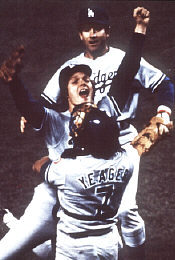
Steve Howe was in his second season
when he helped the Dodgers win the
World Series in 1981. (AP)

April 28, 2006
CBS SportsLine.com wire reports

NEW YORK -- Steve Howe, the relief pitcher whose promising career was derailed by cocaine and alcohol abuse, died Friday when his pickup truck rolled over in Coachella, Calif. He was 48.
Howe was killed at 5:55 a.m. PT about 130 miles east of Los Angeles, said Dalyn Backes of the Riverside County coroner's office. He had been in Arizona on business and was driving back home to Valencia, Calif., business partner Judy Welp said.

Toxicology tests had not yet been performed.

The hard-throwing lefty was the 1980 NL Rookie of the Year with Los Angeles, closed out the Dodgers' 1981 World Series championship and was an All-Star the next year.

But for all of his success on the field, Howe was constantly troubled by addictions -- he was suspended seven times and became a symbol of the rampant cocaine problem that plagued baseball in the 1980s.

During the 1992 season, he became the first baseball player to be banned for life because of drugs. An arbitrator reinstated him after the season.

In recent years, he owned an energy drink company in Arizona.

"I just saw Steve last winter when his son was pitching against my son," former teammate and Angels manager Mike Scioscia said Friday night. "Everything was looking up for him and he looked great. It makes you numb when you hear about a situation like this. He had a roller-coaster ride."

Howe was 47-41 with 91 saves and a 3.03 ERA with the Dodgers, Twins, Rangers and Yankees. His final season in the majors was 1996, and the Yankees released him in June.

A moment of silence was observed at Yankee Stadium before New York played Toronto on Friday night. Howe played for the Yankees from 1991-96.

"I wish more people knew Steve Howe the way I knew him," Yankees general manager Brian Cashman said. "His struggles in life were well documented, but he always tried to fight through them and I will always respect that."

Two days after the Yankees let him go in 1996, Howe was arrested at a Delta Airlines terminal at New York's John F. Kennedy International Airport when a loaded .357 Magnum was detected inside his suitcase. He later pleaded guilty to gun possession and was placed on three years' probation and given 150 hours of community service.

Chicago White Sox coach Tim Raines played with Howe in that final year.

"You always get second chances -- third and fourth sometimes. And people really believed in him and that he'd eventually kick the problem. Unfortunately, it didn't happen for him," he said.

Howe tried a comeback in 1997 with Sioux Falls of the independent Northern League and retired after injuring his forearm. That August, he was critically injured in a motorcycle accident in Montana and charged with drunken driving; those charges were later dropped when prosecutors decided his blood test was improperly obtained.

"He was extremely talented, very confident on the mound and had an incredible arm," Scioscia said. "Obviously, he didn't reach his potential because of other things that crept into his life."
Said former Dodgers manager Tom Lasorda: "Steve played for me for five years and I thought the world of him."

Howe was suspended for the 1984 season by commissioner Bowie Kuhn for cocaine use. Howe was out of the majors in 1986 after a relapse the previous August with Minnesota.

Texas released him before the 1988 season because of an alcohol problem, and he did not pitch again in the big leagues until 1991.

"Howsie had some issues everybody knew about," Arizona manager Bob Melvin said in San Francisco. "Everybody who hasn't played with him didn't know what kind of teammate he was. What you hear about Steve is the drug stuff. ... He was kind of the captain of the bullpen out there."

Welp knew Howe for two years, and said he was doing well.

"His goal was to bring an all-natural energy drink to the United States," she said. "He was so giving, always trying to help people. He used to always say, 'I'm all about the underdog.'"
Giants broadcaster Mike Krukow played against Howe in the NL West.

"When I heard it today, I thought 'What a life this guy had,'" Krukow said, his eyes red. "So many tragic things happened to him in a young 48 years. Maybe he's at peace. He was the nicest guy in the world but he had some demons, unfortunately."

When baseball began checking for steroids in 2005, Howe said he supported a testing program.
"I was one of the first to be fried and tried," he said then.

Yet Howe said he did not think the steroid problem was as big as some believed.

"For whatever reasons, holes have been dug by everybody, so you do what it takes to clear it," he said at the time. "A guy asked me one time, 'Well, how bad is the drug problem in major league baseball?' And I go, 'Go take a survey of your housewives, your doctors, your lawyers, your people down the street, and there you got your problem."'

Howe was 7-9 with 17 saves in 1980, pitching in 59 games as a major part of the Dodgers' bullpen. He played for Los Angeles through the 1983 season.

"He had a lot of talent and his heart was in the right place," former teammate Steve Sax said. "He meant well. He had a lot of opportunities. He just had a lot of problems that he couldn't solve."
Howe's struggles were splashed across the sports pages by the mid-1980s, when cocaine use was baseball's most well-publicized predicament. On Thursday, commissioner Bud Selig said that unlike with steroids, baseball was well aware of its troubles then.

"In the '80s, this sport had a very serious cocaine problem -- and that was a pretty consistent pattern," Selig said.

Howe is survived by his wife, Cindy, daughter Chelsi and son Brian.

AP NEWS
The Associated Press News Service