Sunday, May 29, 2005
Jose "Cheo" Cruz, #25
Tuesday, May 24, 2005
MLB: The true life story of baseballs
Sunday, May 22, 2005
By Mark Roth
Pittsburgh Post-Gazette
As major league baseball games go, the Pirates-Brewers matchup May 13 had a fairly low BU.
BU stands for baseball usage, a statistic that was concocted entirely for this article.
It's a number that attempts to answer a simple question: How do 30 major league baseball teams manage to chew through the more than 900,000 5-ounce spheroids each season?
At a negotiated price of $72 a dozen, including taxes and shipping, the major league tab for baseballs comes to at least $5.5 million a year, which, to keep things in perspective, is less than the median salary of a New York Yankees player.
Still, numbers that big are hard to get a handle on, so it's easier to measure BU by the game.
In the May 13 contest, on a velvety cool Friday evening at PNC Park, the Pirates and Brewers used 104 balls, which is about 15 fewer than in a typical home game, according to Pirates equipment manager Roger Wilson.
That doesn't count the 14 to 15 dozen (168 to 180) baseballs Wilson sends out for batting practice for each home game.
For anyone who managed to last through a childhood summer with one baseball, even if it was wrapped in duct tape by the end, it may be baffling to wonder where all those baseballs go.
The top of the eighth inning in the May 13 game provided telling evidence. The game was tied 3-3, the Brewers were at bat, one batter reached base, no runs were scored, and yet the men on the field managed to use up 11 baseballs.
It started before the first pitch, when Pirates center fielder Jason Bay tossed his practice ball into the stands. It was one of four he personally donated to the fans that night, and one of 13 that players flipped into the seats, often to small boys with gloves bigger than their heads.
At one time, players could be fined for giving away balls, but the public relations value is now so universally accepted that no one says a word.
When play began, the first batter fouled off four balls; the next two batters fouled off two pitches; the umpire gave the catcher three more new balls to replace ones that hit the dirt; and, after the last batter popped out, Pirates catcher Humberto Cota kept the ball and tossed it to a fan.
After nine full innings of such disappearing acts, the BU for this tough 4-3 loss to the Brewers was:
Foul balls, 32
foul tips, 24
balls exchanged by the home plate umpire, 19
balls tossed into the stands by players, 13
balls carried off by fielders as their half inning ended, 8
balls exchanged at the pitcher's request, 4
home runs, 1
wild pitches, 1
and flukes, 2, once when an errant pitch hit Cota and once when Brewers catcher Chad Moeller plinked Daryle Ward's bat trying to throw the ball back to the pitcher.
As the breakdown suggests, home runs make up only a tiny fraction of the balls that leave the field of play.
Last season, major leaguers hit more than 5,400 homers, but that accounted for only one of every 120 balls that were consumed by the sport's voracious maw.
Equipment manager Wilson said that, each season, he orders 300 dozen baseballs a month and 750 dozen for spring training, which is more than 30,000 baseballs a year.
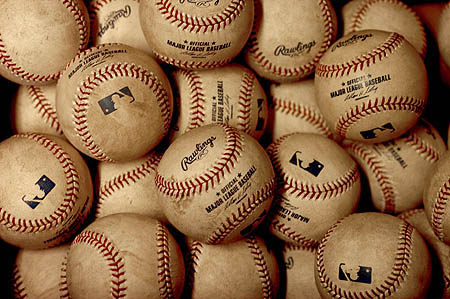
The balls arrive from Rawlings Sporting Goods in boxes, each one wrapped in tissue paper and stamped with the Major League Baseball logo and the signature of Commissioner Allan H. Selig, better known as Bud.
There used to be separate logos for the American and National Leagues, but now it's the same for everyone, just the way that umpiring crews now work in both leagues during a season.
The new balls look as if they've been buffed with tooth whitener, and they're slightly slick to the touch.
For each game, Wilson puts 14 or 15 dozen balls in a wire mesh basket for batting practice. The batting practice balls are either pristine balls right out of the box, or balls that have been used once in a game or once in a previous batting practice.
Ten or 11 dozen game balls go into a canvas bag after they've been "rubbed up" with a special mud that comes from one spot on the banks of the Delaware River in New Jersey.
The official story is that the umpires rub up these baseballs, but the job's actually done by a member of the home team's staff, usually the person who manages the umpires' equipment.
For the Pirates, that's John Bucci. He says one tin of the official Lena Blackburne Rubbing Mud will usually last him a season. Before each home game, he slips on hospital gloves so the grit and odor don't work their way into his hands, pours a judicious dollop of water onto the mud, and works it into the balls, occasionally spitting on them to get the right consistency.
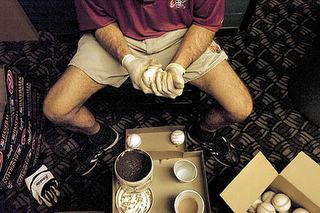
Pam Panchak, Post-Gazette
John Bucci, the umpire attendent for the Pittsburgh Pirates, uses official Lena Blackburne Rubbing Mud to take the fresh-out-of-the-box white sheen off baseballs before a game.
Because the major leagues go through so many baseballs every season, the teams' equipment managers have worked out a barter system for road trips.
Wilson said the visiting team is responsible for providing its own batting practice and bullpen balls, but to avoid having to lug too many along on the plane, the home team will provide a case of balls -- six dozen -- for each game.
On a recent 10-game road trip to Houston, Arizona and San Francisco, that meant Wilson had to take 360 balls with him, and got the other 720 from the Astros, Diamondbacks and Giants. He returns the favor when those teams visit PNC Park.
With baseballs turning over faster than ballpark hot dogs, it stands to reason that the average life span of a baseball in the big leagues is brief.
These days, Wilson estimates, a ball lasts about eight days in the majors.
It is used only once in a game. Then it is relegated to batting practice, where it's used once or maybe twice, if it's not too beat up. From there it goes to the indoor batting cages under the stands for four or five days, and then Wilson ships it to one of the Pirates' minor league franchises, which will use it for practice until it's worn out.
Wilson does look for ways to extend the life of his baseballs.
He'll order as many dozen "blems," baseballs with slight flaws, as he can get from Rawlings for batting and fielding practice.
He has a dishwasher-size machine called a "renewer" which can add a few days of life to some balls if they're merely scuffed. The renewer is a tumbler filled with chunks of gum eraser, which helps remove some of the grass and dirt stains.
Baseballs account for the largest single equipment expense that Wilson makes for the Pirates.
And while baseball easily outdistances its pro sports' rivals -- football, basketball, soccer, hockey and golf -- in total BU, phone calls to the various leagues and sporting goods companies proved that competition is the one constant in American sports.
Virtually every league spokesman either guessed that his sport used more balls than any of the others, or if he could clearly see that wasn't the case, pleaded that each of his sport's balls was probably more expensive.
The only sport that came close?
It's tennis, which uses an estimated 875,380 balls per season for men's and women's pro tournaments, including practice and qualifying matches.
Article courtesy of Pittsburgh Post-Gazette
Sunday, May 22, 2005
The Hidden Ball Trick
The hidden ball trick is one of those rare baseball morsels that comes and goes quickly, a glance in the wrong direction and you missed it. Many think it is extremely rare, but in fact, according to Retrosheet.org, there were 231 of these gems over the years, and several others that are unsubstantiated possibilities.
“It likely is baseball's most famous act of deception and trickery, which results in the victim being greatly embarrassed in addition to making an out. To pull it off, an infielder keeps the ball but tries to make it appear to a runner that he no longer has it. If the runner falls for it and wanders off the base, he is tagged out. The play was more common in the early days before rules were adopted that limited what the pitcher could do to make it appear that he had the ball when he did not. However, it is far from extinct as can be seen in the list below.”
The hidden ball trick confirms that a player wasn’t paying attention, was played the fool, is embarrassed in front of thousands, and laughed at on Baseball Tonight and Sportscenter.
Imagine getting tricked and making the last out in the game. There were eight instances of that happening, including Gary Carter on 4/8/1988. And it was Gary’s 34th birthday, no less. Vada Pinson was also victimized on his birthday, 8/11/1959 when he turned 21.
Two players had it happen three times: Ozzie Guillen (twice in 1989, 1991) and Jack Martin (1912, twice in 1914)
Three players were each fooled twice: Bill Dahlen (1902, 1906), Billy Werber (1937, 1940) and Birdie Cree (1910, 1913)
There must be some connection between a player’s name and his gullibility.
Victims include:
- A Buck (Ewing) and a Bucky (Harris), two Chicks (Fewster, Hafey), a Chief (Zimmer) and a Cupid (Childs).
- Three Docs (Cramer, Johnston, White), a Ducky (Holmes) and a Dusty (Baker).
- A Yost (Eddie), a Flick (Elmer), two Everetts (Booe, Scott), a Gabby (Street), and a Boots (Poffenberger)
- A Mickie (Cochrane) and a Minnie (Minoso), a Rabbit (Maranville), a Goose (Goslin) and a Ping (Bodie).
- A Stuffy (McInnis) and a Topsy (Hartsel), a Vada (Pinson) and Zoilo (Versalles)
- A Deacon (McGuire) and two Patsy’s (Dougherty and Gharrity)
What first name was the most common among victims?
- There were five Jimmys (Jimmie Foxx, Piersall, Sheckard, Slagle, and Wynn)
- Five Willies, (Davis, Horton, Keeler, Mays, Randolph)
- Seven Joes (Benz, Gedeon, Kelley, Keough, Quinn, Sargent, and Tinker)
- Eight Johns (Knight, O’Brien, Roseboro, Vander Meer, Bates, Butler, Evers, Mostil
Charlie Jamieson was the victim as part of a triple play on 4/30/1929, as was Chick Hafey on 9/6/1931.
Chief Zimmer was played the fool on opening day, 4/22/1897.
This famous threesome were also victims: Tinker (Joe), Evers (Johnny), Chance (Frank)
And Jimmy Slagle suffered the embarrassment in game two of the 1907 World Series.
The last one occurred on 9/15/2004 when third baseman Mike Lowell of the Florida Marlins fooled Brian Schneider of Montreal in the 4th inning.
Here is an exerpt from MarlinBaseball.com
MIAMI -- Falling under the heading -- You don't see this every day -- the Marlins successfully pulled off a hidden-ball trick against the Expos on Wednesday in Game 1 of a doubleheader at Pro Player Stadium.All-Star third baseman Mike Lowell caught the Expos napping, enabling the Marlins to pull off a sandlot play.To set the stage, the Expos went ahead 2-1 on Brian Schneider's double. With two outs in the fourth inning, Maicer Izturis was intentionally walked, bringing up pitcher John Patterson.Patterson lined a single to left field. Expos third base coach Manny Acta held Schneider at third, and left fielder Miguel Cabrera ran the ball in. Cabrera flipped the ball to shortstop Alex Gonzalez, who quickly tossed it to Lowell at third.By rule, the pitcher cannot be on the mound when the hidden-ball trick is executed. To keep the Expos off guard, Lowell trotted to pitcher Carl Pavano, and the play was on. In the confusion, the Expos never detected Pavano didn't have the ball.Lowell returned to third, and Pavano milled about the grass around the mound. When Schneider took a one-step lead, Lowell snapped a quick tag, and third base umpire Paul Emmel pumped out Schneider.
Ah yes, the glory of baseball.
Wednesday, May 18, 2005
Julio Franco
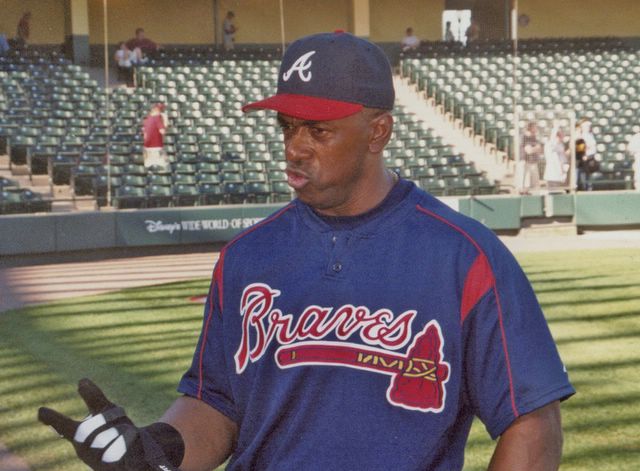
Julio Franco, venerable Atlanta Brave first baseman, will turn 47 this August. Since 1982, he has played in almost 2300 games with over 8200 at bats.
But, to me, the most amazing fact about his career is that, if you study who he has played with, it is a time machine. Just look at who were some of his teammates over the years:
Bert Blyleven
Charlie Hough
Bo Diaz
Steve Carlton
Tug McGraw
Mike Schmidt
Sparky Lyle
Gary Mathews
Pete Rose
Vern Ruhle
Mike Hargrove
Orel Hershiser
Phil Niekro
Tom Candiotti
Nolan Ryan
Pete Incaviglia
Rich 'Goose' Gossage
Jose Conseco
Ivan Rodriguez
Juan Gonzalez
By my unofficial count, Julio Franco has played with 547 different players (and against countless others) in his career and he's still going strong. He started in 1982, has played every year since except three, 1995, 1998 and 2000. In 1999 he only played in one game, one at bat and struck out.
Here is his profile, courtesy of baseballlibrary.com:
One of the most prolific hitters to emerge from the Dominican Republic, Julio Franco started out as one of the best offensive middle infielders of the 1980s, and gradually, due to a bad knee and weak fielding, switched over to the designated hitter position in the 1990s, thriving there as well.
Franco broke in with the Phillies in the early '80s, but didn't last long thanks to his multitudes of errors at shortstop. One of five players sent from Philadelphia to Cleveland for Von Hayes in 1982, Franco soon switched over to second base, thanks to the advice of his friend Manny Sanguillen. Some said the Dominican's immaturity made him a divisive presence during his six years with the Indians, but he was an easy target on losing teams with his weak defense and flamboyant style.
Hitting from a distinctive knock-kneed stance with his bat wrapped high behind his ear, he earned raves in 1985 when he drove in 90 runs, taking advantage of a very high 244 opportunities with runners in scoring position. Franco batted .303 or better in 1986-88, but the Indians continued to lose despite high expectations (one national magazine picked them to win the WS in 1987).
In his early years, Franco was considered a huge defensive liability, leading led AL shortstops in errors in 1984 and 1985, but as the years went on, he made fewer after his fielding percentage was used against him in arbitration hearings. His powerful bat only partly compensated for his lack of range, and he gained a reputation of being unable to make the big play defensively.
In May 1985 the Indians acquired shortstop Johnnie LeMaster and asked Franco to move to second base. Franco balked at taking the job from his friend Tony Bernazard, and LeMaster was sent packing three weeks later. Franco was finally moved to second base in 1988 after Corrales was fired and Bernazard was traded. Before the 1989 season, Franco was traded to Texas for Pete O'Brien, Jerry Browne, and Oddibe McDowell.
He soon emerged as a Rangers team leader and mentor to Rafael Palmeiro and Ruben Sierra. His first year in a Texas uniform, Franco hit .316 with 92 RBI and stole 21 bases in 24 attempts. In 1991, Franco notched his best year, tallying 108 runs, 201 hits, 15 dingers, 36 steals, and a league-leading .341 batting average. He also had a little post-season thrill that year, becoming an American citizen at the end of October. In December of that same eventful season, Franco found God, and became a devout Christian. Unfortunately, the following year, he missed all but 35 games due to a damaged right knee.
Speedwise, Franco never recovered, and was shifted to designated hitter and first base for good following his comeback. When the Rangers didn't resign him after the '93 season, Franco joined the Chicago White Sox, and immediately performed well: In the strike-shortened '94 campaign, Franco was on pace for his best offensive year, slamming twenty dingers before the strike and tallying 98 ribbies by mid-August. When the work stoppage began, Franco wisely packed up and headed for Japan, playing the 1995 season for the Chiba Lotte Marines; the next year, he was back in America, DH-ing and playing second for the Indians once again.
However, after a productive 1996 season, his numbers dropped and he was released in August of 1997. Milwaukee picked him up, and he finished the year with the Brewers before heading off for a second tour of duty with Chiba Lotte. In 1999, Franco played for Tampa Bay's Triple-A Mexico City affiliate, before getting called up to the majors for one at-bat (he struck out). On June 20th of that same year, fellow countryman Tony Fernandez surpassed Franco as the all-time hits leader for a player from the Dominican Republic.
Franco's seemingly dead career was revived for a last hurrah in 2001 by the Braves. Needing a first baseman for the stretch run, Atlanta signed the 40-year-old Franco out of the Mexican League on August 31st. In 25 games with the Braves, he batted .300 with three home runs and 11 RBIs. (JCA/AG/AGL)
[Editor's note: Julio Franco is still playing with the Atlanta Braves in 2005]
Tuesday, May 17, 2005
Charlie Muse, Former Pirates Executive & Batting Helmut Creator, Dies
May 16, 2005
PITTSBURGH (AP) -- Charlie Muse, a longtime Pittsburgh Pirates executive who created baseball's modern batting helmet, has died.
Muse died May 5 in Sun City Center, Fla., at age 87, the Pirates said. He had lived there since retiring in 1989 after 52 years with the team -- many as the traveling secretary. He was renowned with the Pirates for his honesty and thriftiness, often taking public transportation to the ballpark rather than more expensive taxis. He worked for the organization in a variety of roles, including ticket manager and head groundskeeper.
Muse was nicknamed "The Colonel'' because of his all-business approach, and it was his military-like ability to improvise that helped speed the invention of the batting helmet.
Until former Pirates general manager Branch Rickey pushed in the early 1950s for the creation of a protective helmet, batters traditionally wore only their cloth caps to the plate. At the time, Rickey owned American Baseball Cap Inc., and he chose Muse to run the company and design a suitable helmet.
"It (the development) was more difficult than people would think,'' Muse told The Associated Press in a 1989 interview. "The players laughed at the first helmets, called them miner's helmets. They said the only players who would wear them were sissies.''
Muse worked with inventor Ralph Davia and designer Ed Crick to perfect a helmet that was strong, light and aesthetically pleasing. They went through numerous designs before coming up with a comfortable plastic helmet that provided maximum protection above the ears, the most vulnerable area for batters.
Muse later had a prototype of the helmet molded into a lamp that sat on his office desk for years.
The Pirates were the first team to wear the helmets in 1952 and 1953, and their adoption was speeded after the Braves' Joe Adcock was beaned so severely by the Dodgers' Clem Labine on Aug. 1, 1954, that he was unconscious for 15 minutes.
Adcock said the helmet may have saved him from a severe injury, and the next day the Brooklyn Dodgers ordered all players in their organization to begin wearing helmets. Other teams quickly followed.
"There's no doubt about it, there was tremendous personal satisfaction from seeing the helmet become popular ... to see it save players from serious beanings,'' Muse said in 1989.
Muse was a minor league catcher and manager before and after serving as an Army captain in World War II and the Korean War, and occasionally donned catcher's gear even in his early 70s to catch spring training batting practice.